

.jpg)


This will be my third and final blog about our time in Louisville. However, very soon I'll be posting about our stayovers at Carter Caves Resort State Park on the way to and from Louisville.
A lot of folks probably wouldn't get as excited as we did over visiting a water treatment plant and an old cemetery. But Judy and I (plus Charlie and Liz) could probably author a book on how to build a whole vacation around free or cheap thrills.
I think it takes a city with a lot of imagination and pride to see a water plant as historically significant. But they do a great job selling that concept. The Louisville water works is celebrating its 160th year of operation. I wonder how many cities even dreamt of providing city water in those pre-Civil War days.
This photo is inside the Gatehouse, where the flow of water from one area to another was once controlled. Charlie and Liz told us that even though they had frequently walked in the area, this was the first time the historic gatehouse was open to the public. Judy and Liz examine one of the displays explaining the design and function of the waterworks.

Places like this always inspire Liz to revive the Romeo and Juliet balcony scene. Actually, a retired water plant employee gave us a personal presentation on the whole operation, history and all. He told us every step the water went through from the Ohio River to our own household plumbing. The smart aleck in me couldn't resist telling him how amazing that was-- since we lived in Pinehurst, NC. He was unperturbed, though. He reached into a cooler and handed each of us a bottle of Louisville Pure Tap water. It even had fluoride added! And 0 grams of fat! I didn't try any more snappy comebacks.

We then proceeded across a walkway separating the two giant holding pools. From there, you get the best view of the Gatehouse, which was designed based on French architecture on the Rhine and Rhone Rivers. Our guide was the person responsible for saving the original blueprints and drawings for the construction of this architectural and historical wonder.

Many people were walking laps on the perimeter of the holding pools.


Both the colonel and his lady (as the tombstone calls her) were laid to rest here. But these are by no means the largest or most flamboyant monuments in this cemetery.

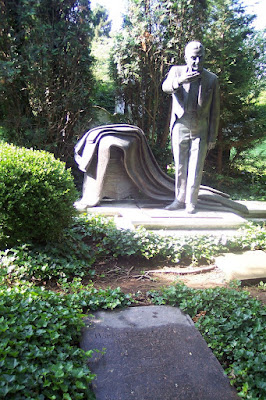
The gate guard also directed us to "The Magician." I won't go into the details, but this was a beloved performer whose family honored him with a life-size sculpture.

A lot of folks probably wouldn't get as excited as we did over visiting a water treatment plant and an old cemetery. But Judy and I (plus Charlie and Liz) could probably author a book on how to build a whole vacation around free or cheap thrills.
I think it takes a city with a lot of imagination and pride to see a water plant as historically significant. But they do a great job selling that concept. The Louisville water works is celebrating its 160th year of operation. I wonder how many cities even dreamt of providing city water in those pre-Civil War days.
This photo is inside the Gatehouse, where the flow of water from one area to another was once controlled. Charlie and Liz told us that even though they had frequently walked in the area, this was the first time the historic gatehouse was open to the public. Judy and Liz examine one of the displays explaining the design and function of the waterworks.
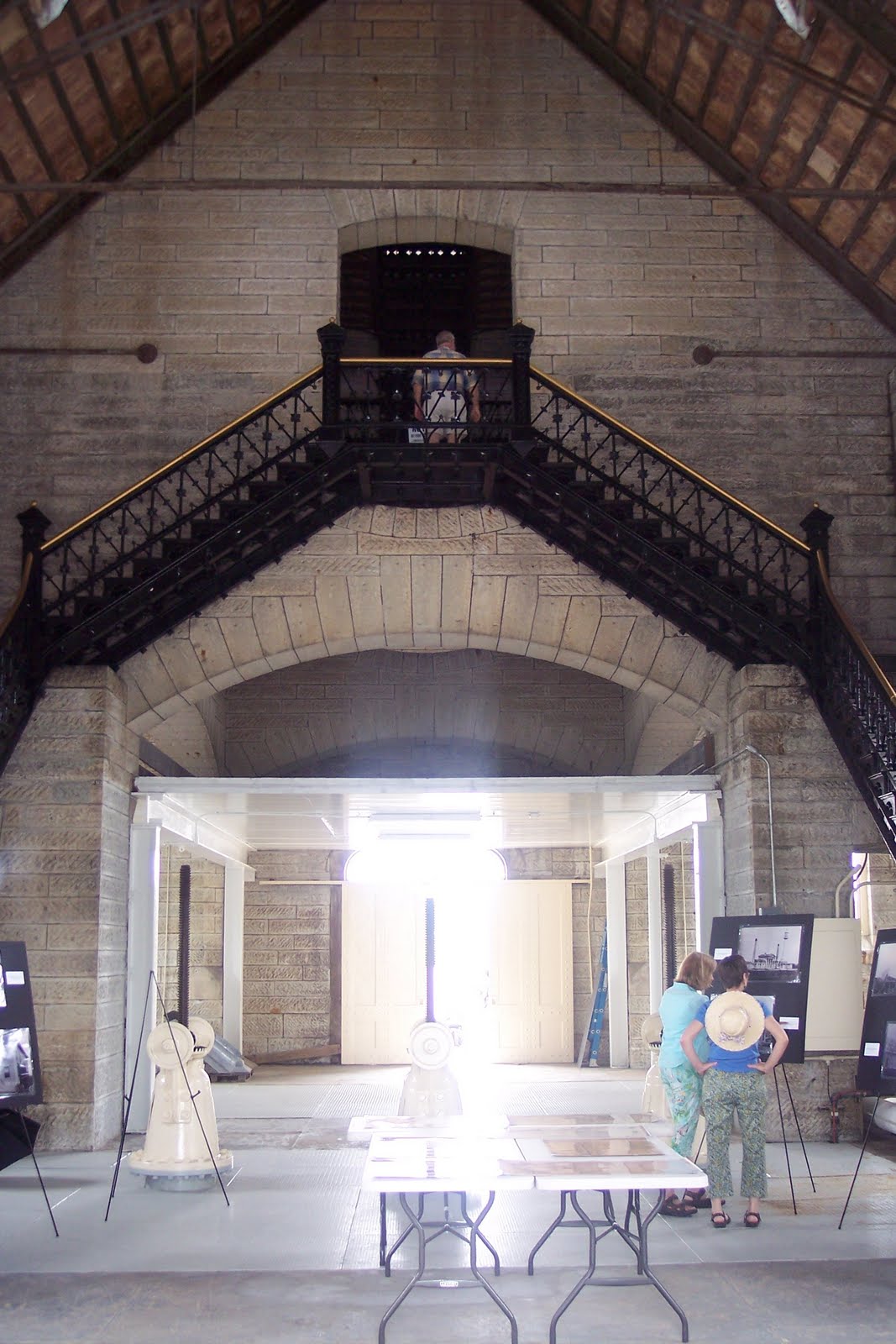
Places like this always inspire Liz to revive the Romeo and Juliet balcony scene. Actually, a retired water plant employee gave us a personal presentation on the whole operation, history and all. He told us every step the water went through from the Ohio River to our own household plumbing. The smart aleck in me couldn't resist telling him how amazing that was-- since we lived in Pinehurst, NC. He was unperturbed, though. He reached into a cooler and handed each of us a bottle of Louisville Pure Tap water. It even had fluoride added! And 0 grams of fat! I didn't try any more snappy comebacks.

We then proceeded across a walkway separating the two giant holding pools. From there, you get the best view of the Gatehouse, which was designed based on French architecture on the Rhine and Rhone Rivers. Our guide was the person responsible for saving the original blueprints and drawings for the construction of this architectural and historical wonder.
Many people were walking laps on the perimeter of the holding pools.

As we departed, these roaring waters being pumped into the holding tanks from pipes 40 feet underground once again reminded us of man's ingenuity. Us modern folks have no right to feel superior to our predecessors, who achieved astonishing technological success with far fewer resources than we have access to.
From the waterworks, we proceeded on to Cave Hill Cemetery, easily the most sprawling and interesting graveyard I've ever seen. I fell in love the place, even if none of my relatives are buried there-- as far as I know.
But some famous people are buried there. The most famous is probably Colonel Harland Sanders, founder of Kentucky Fried Chicken. The guard at the gate directs people to follow the yellow line to this site almost before you can inquire.
Both the colonel and his lady (as the tombstone calls her) were laid to rest here. But these are by no means the largest or most flamboyant monuments in this cemetery.
The gate guard also directed us to "The Magician." I won't go into the details, but this was a beloved performer whose family honored him with a life-size sculpture.
No, he didn't reappear while we were there. A eulogy on his monument were a testimony to how he had endeared himself to his audiences over the years.
 Geese and swans were everywhere as we continued on to this picturesque pond. Across it was the cave the cemetery was named for. It is closed to the public, so we didn't walk around to get closer.

 Geese and swans were everywhere as we continued on to this picturesque pond. Across it was the cave the cemetery was named for. It is closed to the public, so we didn't walk around to get closer.
Here, Judy and I are posing under one of the largest Chestnut Oak trees I've ever seen. There were ancient trees throughout the grounds. And greener grass you'll never find-- thank the geese, I suppose. Don't spend too long trying to decide if it's Kentucky bluegrass.

Uh oh. It's a faceoff between humans and geese. The humans freeze. Will there be fowl play? Finally in a tense scene worthy of Hitchcock, the birds let the humans pass unmolested. "But watch your step," they cautioned menacingly.


Uh oh. It's a faceoff between humans and geese. The humans freeze. Will there be fowl play? Finally in a tense scene worthy of Hitchcock, the birds let the humans pass unmolested. "But watch your step," they cautioned menacingly.

Obviously not worried about similarities with "Night of the Living Dead," Judy and Liz posed beside this lovely bench, which was inscribed with some sentimental and inspirational quotation.
 Now if this blog has put it into your head to visit your local water treatment plant or cemetery, I hope you're not disappointed. Louisville is a hard act to follow. But on the other hand, most of our communities do have some pretty impressive local landmarks and special places. Next chance you get-- when the temperature is below 90-- why not do a little exploring of the place you call home!
 Now if this blog has put it into your head to visit your local water treatment plant or cemetery, I hope you're not disappointed. Louisville is a hard act to follow. But on the other hand, most of our communities do have some pretty impressive local landmarks and special places. Next chance you get-- when the temperature is below 90-- why not do a little exploring of the place you call home!


