Tuesday, September 13, 2011

The Road to Camden . . . and Home Again

In my preceding blog, I introduced you to Camden House,
the wonderful Bed & Breakfast where Judy and I stayed on our recent visit to Camden, South Carolina.  I intentionally saved discussion of the many other sights we saw on our trip.  This review of what we did is not chronological, but will give you a pretty good idea of what we saw in a mere 30 hours 30 minutes.  Without rushing!

This bronze sculpture was in the Camden Public Library, which was only a couple of blocks from Camden House.  We visited it before dinner the day we arrived.  You can tell a lot about a town by the investment they make in their library.

It was particularly difficult to decide where to dine that night.  Some fine places were recommended, including Sam Kendall's and the Armory Steakhouse.  But a nice lady at a thrift shop told us her preference was "CHOP."  She explained that it was short for Camden House of Pizza.

Yep, that's where we ended up, and we were not disappointed.  And the lady who mentioned it to us hopped up from her table and greeted us at the door.  She said, "If you just stand here a while, somebody will get up and leave."  That's right, there was not an empty seat in the house!  That's quite a recommendation for ANY restaurant.  As it happened, the lady's group was finishing up, and we pushed a table for two away from their table for six.
Not only did CHOP feature authentic Italian AND Greek fare, the wall-to-wall Mediterranean-theme murals provided plenty of atmosphere.  We loved our meals. 

We did an after dinner walk as well as an after dinner drive around town.  At one of the many parks we stopped, this warning sign for litterbugs caught my eye.  Read the fine print.  I guess if the fine was five dollars more you might get the electric chair.

It was impressive to hear the hour tolled at dusk from this clock and bell tower in the heart of downtown.

Couldn't resist photographing these wasps, safely on the other side of the window in our B&B.

As South Carolina's most important inland town in colonial days, Camden was an obvious target of the British during the American revolution.  There are constant reminders of this fact all around town, including the cannon in this park.

This park was one of numerous pleasant places we discovered for walking.

In another park we found, I was thrilled that the pieces of this fallen tree had been sawed and left for children to play on.  I'm a big fan of imagination playgrounds.  I know there are risks of injury, but the same is true of commercial play equipment.  Give me the homemade variety any time!

I had read about the Battle of Camden before.  I knew the British had captured it after fierce fighting and heavy losses on both sides.  What I didn't know was that the Americans made two unsuccessful attempts to recapture the town in succeeding years.  The Battle of Hobkirk Hill took place over a wide area covering several long city blocks to the north and east of our B&B.

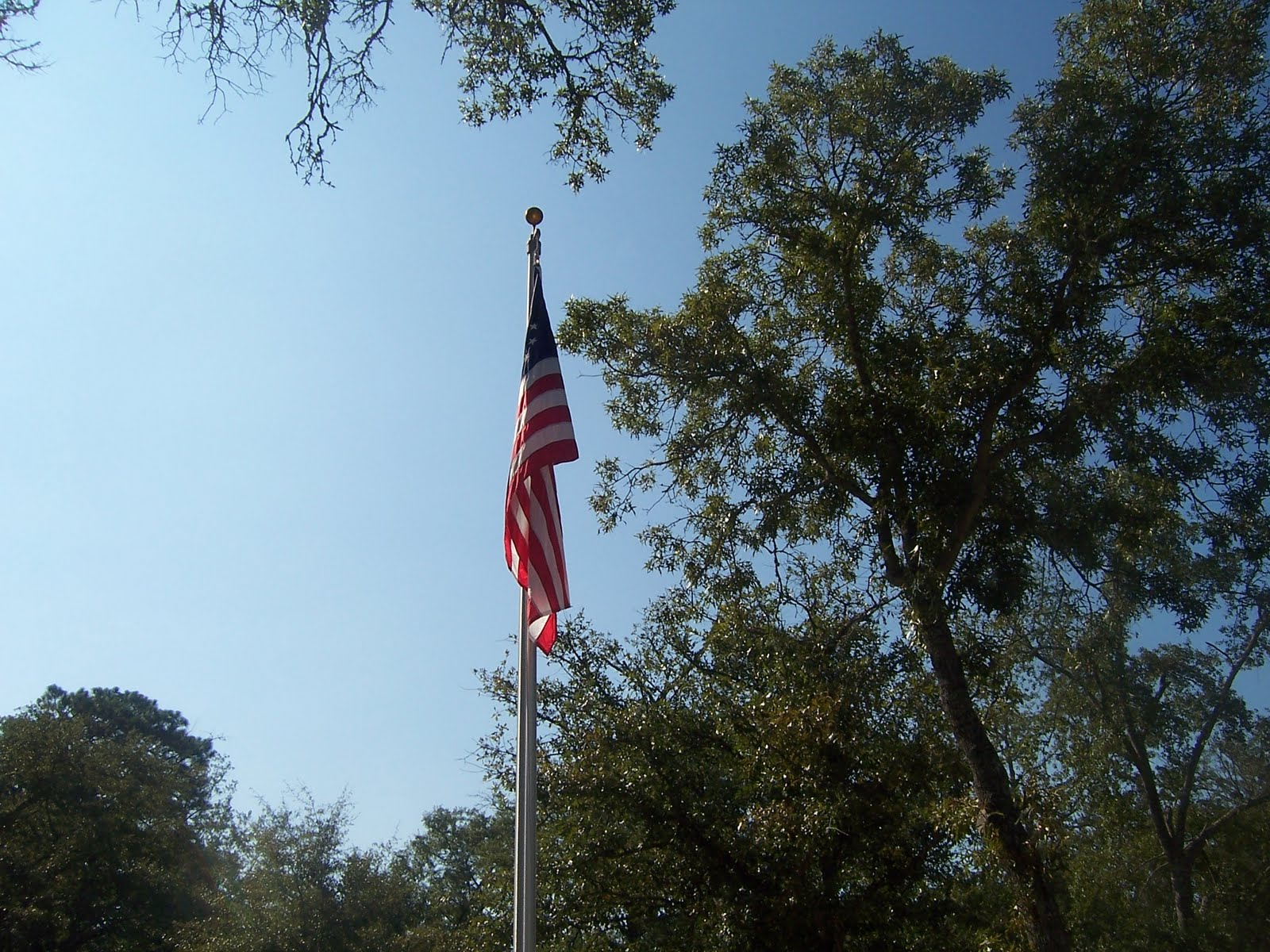
We walked several blocks, including Greene Street (for American General Nathaniel Greene-- George Washington's right hand man).  Below, a British flag flies beside the Stars and Stripes.


It is well worth contemplating what happened in this now quiet neighborhood 230 years ago.  Though the patriots were repelled here, the British would slowly suffer from a war of attrition here and later at Cowpens and King's Mountain.  The weakening of their forces resulted in their withdrawal to Yorktown, where a "perfect storm" surrounded them at Yorktown, Virginia, with Washington's army blocking escape by land and a French fleet successfully blockading their supply by sea.  It was the perseverance of the patriots at places like Camden that led to the ultimate defeat of the British.  It truly was their Viet Nam.

DeKalb Street is the street that crosses Broad Street (where our B&B was located).  The name has special significance to me, since I was born and raised in DeKalb County, Georgia.  Baron DeKalb, who died from many wounds in the first battle at Camden, was one of many idealistic European nobles who lent their skills and leadership to the cause of American freedom.  Unlike the mercenary Hessian soldiers who often failed the British when under fire,  DeKalb and others had caught a vision of what this new country could be, and they were willing to risk their lives beside us to help that vision become reality.

Judy and I are not "horse people," but I should note that Camden is something of a sister city to Southern Pines, NC on the equestrian circuit.  Judy grew up with the famed Stoneybrook Steeplechase virtually in her back yard.  Camden is often the next stop for the horses and riders.

I will not attempt to summarize the historical details in the following pictures, but you can read all about the facts of the battles of Camden and the men who made history here by clicking on any picture to enlarge it.

At the Camden Revolutionary War Park, there is a walking tour, either guided or unguided, and a nice gift shop.  I photographed the pillories, or stocks that were common in colonial times for public humiliation/punishment, and also some battlefield relics that were on display.


The cemetery below was in Cheraw, not Camden.  I was struck by the number of Confederate battle flags marking many graves.  When I checked on Wikipedia, I found that North and South Carolina are two of the thirteen states that still celebrate (or at least "recognize") Confederate Memorial Day or Confederate Heroes Day.  The date varies widely among those states.  I have not heard this day referred to since I was a school boy in Georgia.

Just an hour and a half from home, we stopped at the Carolina Sandhills National Wildlife Preserve, where we had picnicked on our trip down.

This time, we took the time to take the 22 mile round-trip Wildlife Drive.  Knowing what we know about the somewhat sparsely populated sandhills, we weren't expecting to see herds of deer or a mother fox with her kits.

But what we DID see was some of the most beautiful scenery we had ever seen in the sandhills.  This was well worth the drive.


We spent a few quiet moments watching this crane patiently pursue his lunch.  He was undisturbed either by us or some nearby workmen repairing an observation platform.
Yes, we saw all this and more in just 30 hours and 30 minutes.
It was wonderful and refreshing trip.  Since we've been home, we've had even MORE fun, as we've resumed babysitting.  Some pictures of that will be coming up soon (but you probably knew that)!

Destination: Camden House

In what I can say with reasonable certainty was the last of our summer travels, Judy and I just spent a relaxing time in historic Camden, South Carolina.  This was a 30/30 trip.  Thirty hours and thirty minutes.  In my next blog, you'll see what we did in that short time span.  You may believe it or not, as you choose.

But today's blog is reserved for the superb bed and breakfast that was our comfortable home away from home for this getaway: Camden House.
Judy and I have been through Camden literally hundreds of times over the years, because it lies conveniently at the junction of U.S. Highway 1 and Interstate 20 on our route to Atlanta.  We had spent a night there some years ago in a generic motel, but this was to celebrate our 35th wedding anniversary, and we were in search of a place not too pricey, beautiful but homey, and special enough to be a destination in itself.

Camden House was all of those things and more.  Hosts Paul and Sharon have not overlooked anything in preparing to pamper guests.  And their amiable helper Marvin made sure we were happy.

This is the first view of Camden House from tree-lined Broad Street.

Is it a historic house?  Yes.

Let's get past all those trees for a better look.

Yes, it was really this nice.

Camden was the first inland colonial town in South Carolina. 
And Camden House was the first in-town plantation in town.

The following three pictures are all downstairs parlors, sitting rooms, or whatever you wish to call them.  They speak for themselves.  Paul and Sharon were kind enough to let me play the piano for half an hour before breakfast.


The kitchen is not really part of the standard tour,
but Sharon happily showed us around. 
They designed it themselves.

And this is the elegant dining room where a
delicious traditional breakfast was served to us.

Let's head upstairs to the guest quarters.


This cute pup welcomed us. 
 He and his sibling get to live here all the time.

We stayed in the well-appointed Allison Room.

We had everything we needed, including a
 queen-size bed and private bath.


The morning we departed we walked the expansive grounds.

An in-ground pool is something Camden House
 featured that many B&B's don't have.

The outdoor lighting in the evening was breathtaking.
A particular advantage for me and Judy was the excellent neighborhood for walking.  I'll mention more about what we saw on our walks and drives in my next blog.  If you're looking for a relaxing day or two away from home, Camden is just two hours from Moore County.
You can find out much more about the rooms, amenities, and local history at http://www.camdenhouse.us/.
The accompanying blog about sights on our trip will be up soon.

Wednesday, September 7, 2011

THE QUINCUNX


This 1989 novel was recommended to me by my brother many years ago.  Only last month did I finally pick it up and embark on the journey through its 938 pages.  If only I had known what delights it held in store, but I don't know how long it would have taken me to read it if I had attempted it prior to retirement.  I read it day and night, snatching minutes here and there, because it drew me onward irresistibly, with unpredictable twists even unto the end.

The Quincunx is not a book I would recommend for everyone.  And I do not even feel qualified to summarize or explain all the reasons I love it.  So I have borrowed a review from the website goodread.com and several reader appraisals for you to peruse if you so desire.

The Review:
"The epic length of this first novel—nearly 800 densely typeset pages—should not put off readers, for its immediacy is equal to its heft. Palliser, an English professor in Scotland, where this strange yet magnetic work was first published, has modeled his extravagantly plotted narrative on 19th-century forms—Dickens’s Bleak House is its most obvious antecedent—but its graceful writing and unerring sense of timing revivifies a kind of novel once avidly read and surely now to be again in demand.
The protagonist, a young man naive enough to be blind to all clues about his own hidden history (and to the fact that his very existence is troubling to all manner of evildoers) narrates a story of uncommon beauty which not only brings readers face-to-face with dozens of piquantly drawn characters at all levels of 19th-century English society but re-creates with precision the tempestuous weather and gnarly landscape that has been a motif of the English novel since Wuthering Heights. The suspension of disbelief happens easily, as the reader is led through twisted family trees and plot lines.
The quincunx of the title is a heraldic figure of five parts that appears at crucial points within the text (the number five recurs throughout the novel, which itself is divided into five parts, one for each of the family galaxies whose orbits the narrator is pulled into). Quintuple the length of the ordinary novel, this extraordinary tour de force also has five times the ordinary allotment of adventure, action and aplomb."

Now for reader comments:

"If every other novel was like this it would be terrible. I'd never leave the house. I'd call my office : "Sorry, can't make it today, I have 450 pages to finish, I'm sure you'll understand, put it down as a family emergency" and eventually they'd email me - "you're fired" - but I wouldn't read the email. My cat would have to become feral. Empires might tumble, Bob Dylan might be chosen as the next Pope; I wouldn't notice."

"At first I thought this was an imitation of a Victorian novel, then a complete recreation of every Victorian novel, and finally I decided it was a parody of and commentary on the Victorian novel. It had every Victorian trope imaginable: the lost inheritance, the fatherless hero, the consumptive beauty, the abandoned manor, the mysterious break-in, the lost birth certificate, the evil money-hungry miser, the intolerable boys' school, the nightmarish insane asylum, the missing will, the charming crook, the grave robber, the poor starving governess, the vermin-ridden slums, and so on and so on, all packed into one frustrating yet compelling plot. At the climax comes the obligatory wedding, only it doesn't play out the way Dickens' versions did. It's absorbing, despite the occasional and annoyingly heavy-handed Victorianisms -- when you can practically hear the ominous music in the background -- which you have to forgive, because they're actually part of the whole parody/send-up. Upshot: a fun read and lit class rolled into one."

"The Victorian novel reborn, but without so many boring bits."

"This was a wonderful book, full of twists, turns and revelations up until the very end. Incredibly well researched and completely realized, down to the dialects and the slime of 19th century London sewers. In the best traditions of the era, Palliser gives us horrifying stories of poverty, betrayal, vengeance, Justice sought and denied, inheritances lost, stolen, regained, stolen again, forbidden loves, "unfortunate circumstances" resulting in illegitimate and unknown descendants, genteel ladies declining genteelly into drugs and prostitution, street philosophers of vivid eloquence, flash thieves and grasping moneylenders. With almost 800 pages of small type in the hardback edition, you certainly get your money's worth (though I borrowed mine from our little library). Not necessarily a book to get lost in and devour in a few sittings, but definitely one to come back to regularly and to look forward to."

I would love to hear from any of you that accept the challenge this book presents.  But I bet I won't hear from you for at least a month!

Saturday, September 3, 2011

The Mountains Keep Calling Us Back

This past week found us right back in the North Carolina mountains.  The occasion was that we had a chance to go with Judy's mom and dad, and we jumped at the opportunity.  This time we stayed in an almost new Hampton Inn, and boy, were we impressed.  The service, facilities, and amenities were impeccable.  Even the continental breakfast looked superb, but we passed it up to locate some local fare, which turned out well.

The next two pictures show the view from the front of the motel.  Judy and I had this same view from our room.  The nice lady at the front desk also told us to look out at night to see three mountaintop crosses that were illuminated by solar lights.  Didn't get a picture of that, but we viewed it each night.


We had our first dinner and breakfast the following morning at old favorite Shatley Springs.  This time we sipped a little water from the old spring which is reputed to have healing properties.  Since I wasn't ailing at the time, it's hard to say if it works.

Judy and I had eagerly awaited another visit to the Ashe County Museum, housed in their old 1904 courthouse.  This is the view of Mount Jefferson from in front of the museum.  We enjoyed a good long visit this time and talked at length with the curator, who answered all our questions.  The kind lady volunteers shared their knowledge about the history of Shatley Springs.  They gave us a copy of the testimonial of the man who discovered those springs, who was healed of a painful skin disorder after every other remedy had failed and doctors had given up hope.

Judy and her parents on the front steps of the old courthouse.

Like many other places, Ashe County is featuring Civil War history during this sesquicentennial (150th anniversary).  There had been a recent reenactment among many other planned activities.

This mural, one of many in West Jefferson, shows the old Virginia Creeper that once traversed these mountains, with whistlestops in many small towns.  This one was done by Stephen Shoemaker, guru of mountain mural makers.  He reportedly delights in hiding something in everything he paints.  We saw one of his paintings in the museum that had a feather hidden.  Another train painting showed an ominous skull far below a trestle.  I wonder what's hidden in this picture.  Click on it to enlarge and search, if you like.

This mural is on the north side of the Ashe County Cheese Factory, the largest in North Carolina.

These cows welcome visitors to the cheese factory.  We had all been there before, so we didn't take the tour.  If you've never been there, it's interesting and worthwhile.

After supper at Smoky Mountain Barbecue on our second night, we cruised the backstreets of West Jefferson for a while.  We happened upon this wonderful town park, which Amanda later recalled we had taken her to years before.  Who could forget this slide, the highest and longest I've seen at a public playground?

HOLY GUACAMOLE!!!

On our way back to a walking trail in Jefferson, we stopped off at the Dairy House for ice cream/milkshakes.  Then we walked off ALL the calories!

Here are some downtown scenes from the old railroad towns along the Virginia Creeper's route.


I didn't want to tell you in advance, but the previous four pictures are from a diorama in the Ashe County Museum.  It is still a work in progress, carried out with painstaking care and attention to authenticity by a group of at least a dozen local artists and artisans.  The finished display will be some 30 feet long and will show some of the railroad towns as they would have appeared in different eras, from the 20's through the 50's.  Actual events and characters from local history and anecdotes are added whenever possible.  The depth of detail is astonishing.  Here is the preparation area for the remainder of the project.  The curator of the museum told me that the artisans generally gather on Wednesday evenings and Saturday mornings and share coffee and anecdotes as they work.

You may click on the picture below for an interesting summary of the Virginia Creeper's history, from the boom years to its eventual demise.

We did much more on our trip that I didn't take pictures of.  We located the old Greenfield Campground and the former Lee's Lodge (now an art school) which Jack and Thelma recalled from days gone by.  We visited some other places that Judy and I had been to on our trip in July.  If you'd like to see more pictures of those, visit my July blogs.  Thursday, we returned home refreshed, having avoided the Labor Day traffic, enjoying fine dining and the very best of company throughout our journey!