

.jpg)


A specialty of mine and Judy's is finding day trips
less than 90 minutes from home. We've done it again.
Full disclosure, we went to a place we went to some
20 years ago, but found it much different.
From Southern Pines, we followed NC Highway 22
through Carthage, Highfalls, Bennett, Coleridge, and
Ramseur. There it crossed Highway 64. Still following 22,
we came in no time to the old mill town of Franklinville.
We were here to visit Faith Rock, which has a famous
Revolutionary War anecdote to its credit. More about
that later, but let's begin our tour.
 |
| This sign gives you the basic info to find Faith Rock at the Franklinville Town Park, adjacent to the Deep River. |
 |
| We remembered this impressive structure from years ago. It affords great views up and down the river. |
 |
| Up river was the site of an old mill of yesteryear, in fact, dating back to 1840. |
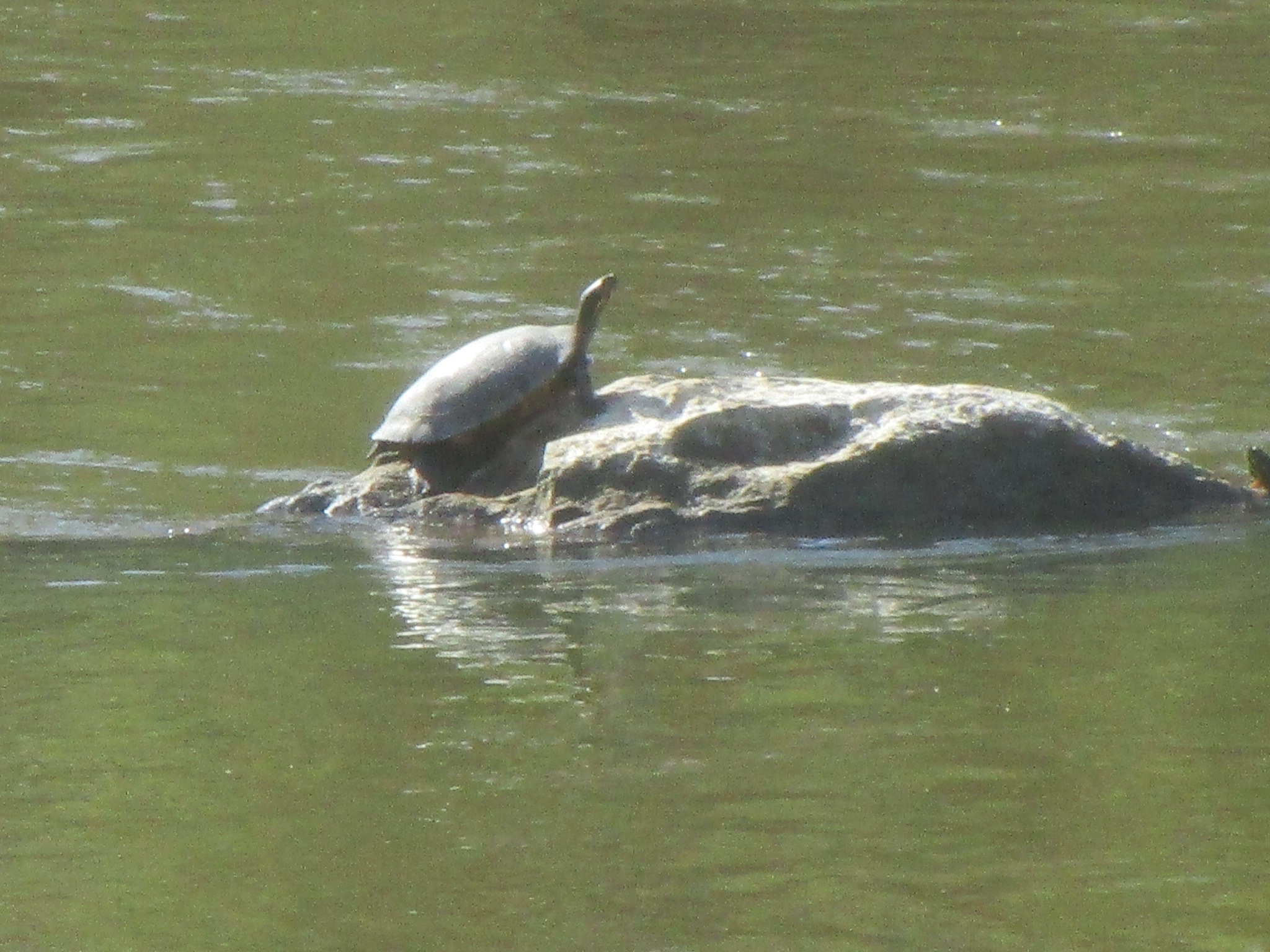 |
| We were warmly greeted by a venerable old caretaker, Brother Terrapin. |
 |
| Those rapids are the reason this was an ideal spot for a mill in those days of water power. |
 |
| Across the sturdy bridge was our loop trail to Faith Rock. |
 |
| A curious crowd of onlookers gathered when they heard there were some new folks in town. |
 |
| As in much of the North Carolina piedmont, there were fascinating stone formations. |
 |
| We ascended a fairly easy trail, with a view of the river and bridge most of the way. That might change once the hardwood trees are in full leaf. |
 |
| If you have a vivid imagination, you might see something in this gnarled old stump. Please let me know what you think you see. |
 |
| As we neared Faith Rock, we could see the bridge where Andrew Hunter Road crosses the Deep River. |


 |
| If you can enlarge this, you can read all the details of how Andrew Hunter (yes, the one the road is named after) made a daring escape from Tory leader David Fanning, on Fanning's own horse. The daring part was riding the horse down the steep slope of the 50 foot rock into the Deep River and to freedom. One of countless amazing stories of the Revolution. |
 |
| If you stand on that rock, you'll realize what a display of courage, and yes-- desperation, was required. But, as they say, nothing ventured, nothing gained. |
 |
| We met a most friendly and helpful local gentleman who advised us to lean backward if we went any further down. We were not at all tempted. |
 |
| Faith Rock |
 |
| An apt setting for a "Leap of Faith." |
 |
| When we had marveled at the rock and the story long enough, we continued on the loop trail. Every few feet we stopped so I could document the array of spring wildflowers. I won't attempt to name them all, but this one is Trout Lily. It is past blooming time, but never had we seen hillsides more covered with a single species. It was EVERYWHERE! |
 |
| A velvet-leafed specimen, not yet in bloom. |
 |
| Some dainty white flowers grow in a cluster. |
 |
| Even away from Faith Rock, we saw more impressive rock formations that could easily dump you right into the cold water. |
 |
| Two of my favorite plants are in this shot: Wild Ginger and Pipsissewa, or Spotted Wintergreen. Frequent readers of my writings may recall that Pipsissewa was my Indian name at Camp Cherokee 50 years ago. |
 |
| Along the upper trail, we had a good view of the ruins of a more modern manufacturing plant. |
 |
| Leave it to Judy to spot some blueberries! Or at least the blooms. |
 |
| A lovely yellow sample. |
 |
| This mossy overlook seemed like it was designed for a private little prayer spot. |
 |
| Even though it was soft, getting up from that low is never easy nowadays. |
 |
| A very different white flower. |
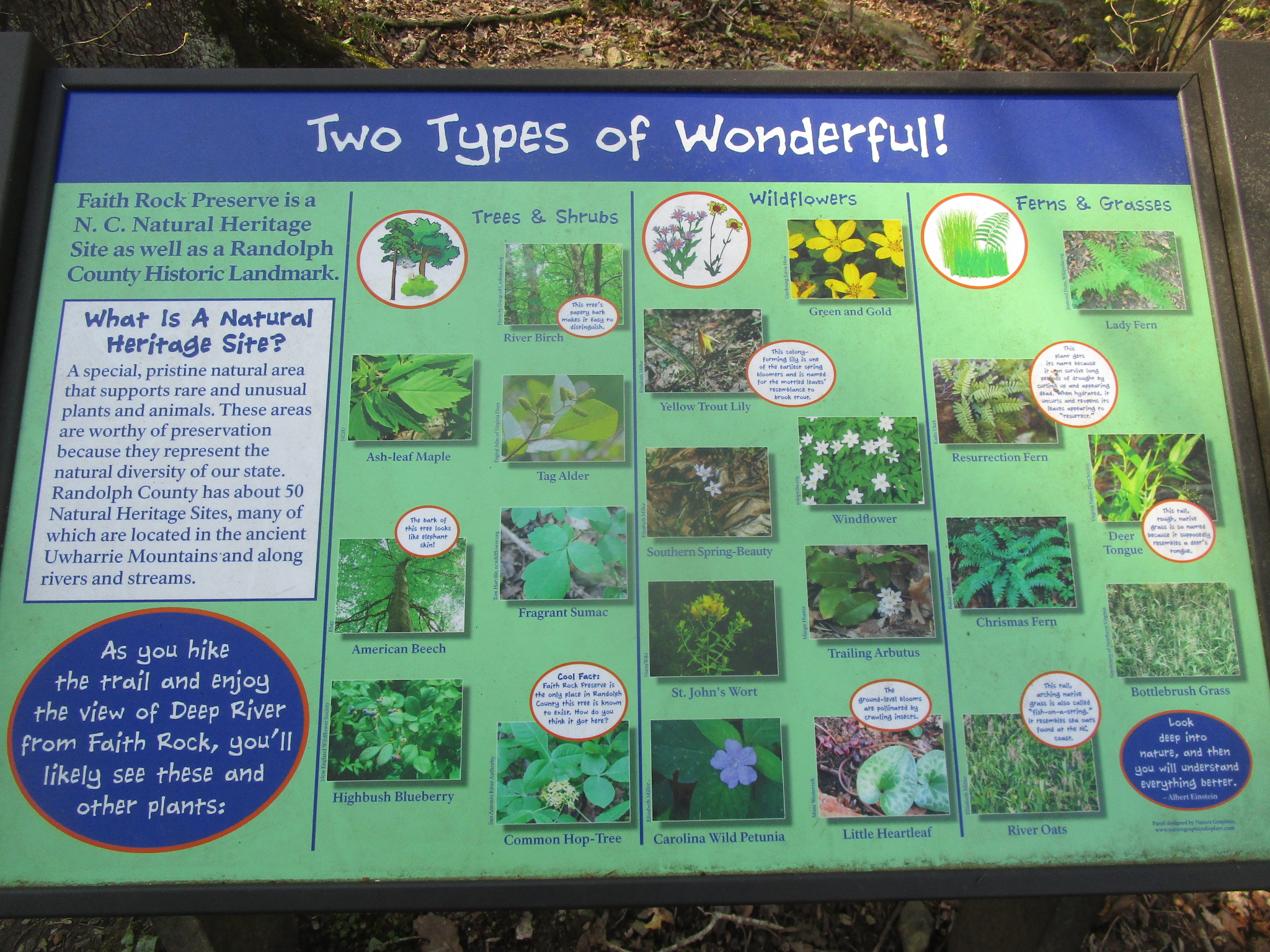 |
| Someone has gone to a lot of trouble to make this place educational. |
 |
| Now Judy has found a sweet shrub, which has one of the most appealing fragrances to be found in nature. |
 |
| A little more historical background. To examine some REALLY interesting local history, visit this blog: https://www.sweetteaandpasta.com/mills-of-the-deep-river-in-north-carolina-franklinville-in-photos/ |
 |
| If you live in central North Carolina, you could have easily been within a short distance of the interesting town of Franklinville without ever visiting it. |
 |
| Here is one more VERY good reason to visit: the Franklinville Diner. |
 |
| Their sign does not exaggerate. |
 |
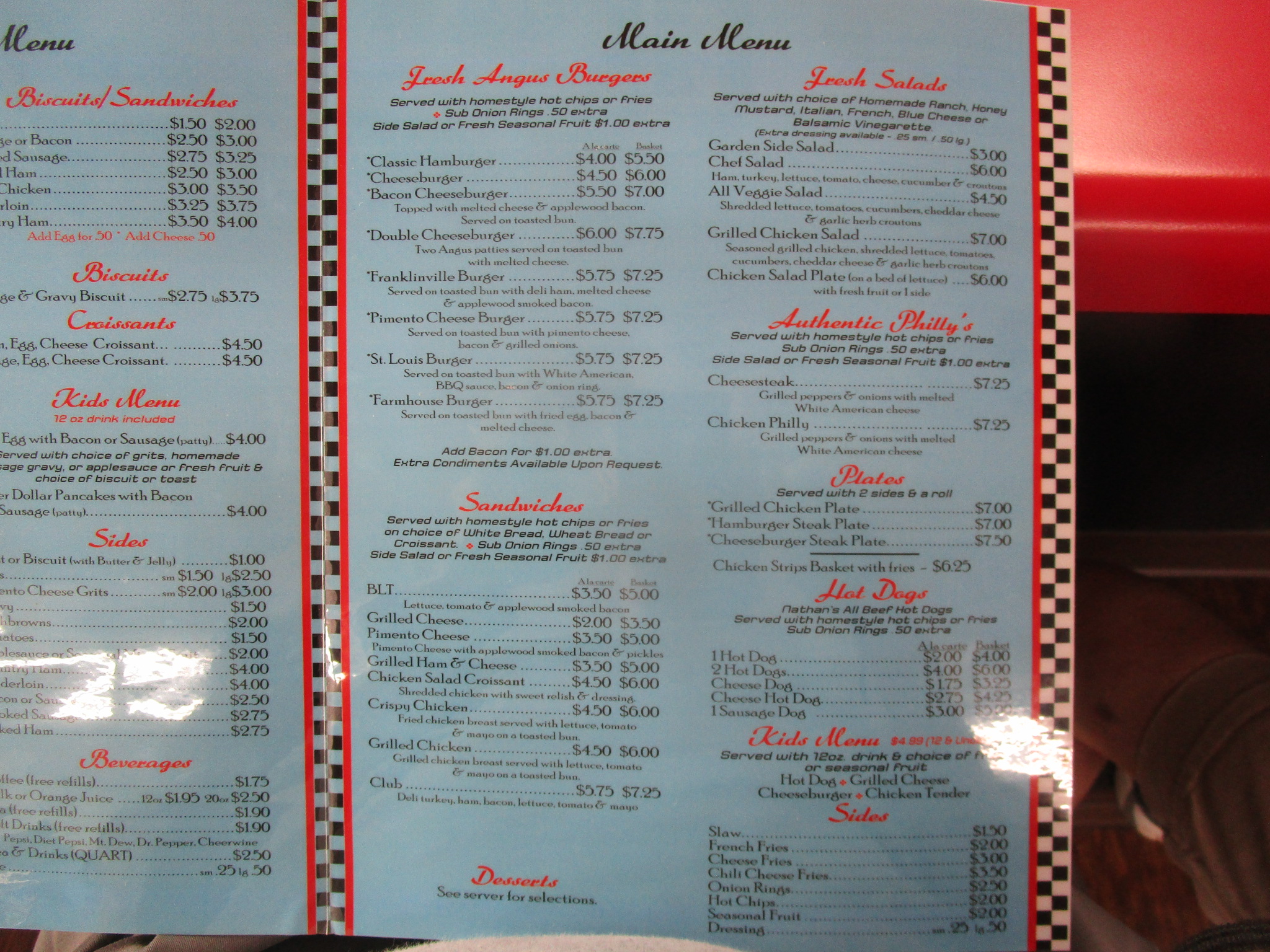
| Here and below are the items on their extensive menu. |
 |
| Something NOT on the menu is the daily special, which today was country style steak with three vegetables. |
 |
| Judy got the special without the steak, and her generous portions of pintos, cabbage, and taters was $4.50. |
 |
| Personally, I couldn't resist the Franklinville Burger. A fist-sized hamburger patty, a slab of ham, good, crispy bacon, and cheese really filled up that bun. And the onion rings with homemade ranch dressing was the perfect side. |
 |
| We opted to carry our take-out plates to the town park, just around the corner. Nice covered shelter and a playground, right beside the Deep River. |
 |
| There were plenty of ducks frolicking in the river, sensing there was no danger to them here. |
 |
| Before leaving the park, we followed the bank a short distance to see the ruins of the oldest mill. |
 |
| You would think you couldn't go wrong on this trail. And you'd be right. However, we drove about a mile to another section of the trail for an after lunch walk. |
 |
| Here are a couple of pictures of the massive ruins of the mill of yesteryear. |
 |
| I can scarcely guess the function of some of these remnants, but it's fascinating to see what remains. |
 |
| So just a short drive back toward Ramseur, we parked in a little community called Living Well. It's almost like a commune of nature lovers/respecters. We entered this trail by passing by the old water treatment plant. Warning!! At times it emits foul odors, but when we walked there in the afternoon, we smelled nothing amiss. |
 |
| Along this nice, level path we would see still more colorful flora. This one is Green and Gold. |
 |
| More massive rocks point to the river. |
 |
| I couldn't tell if a flood had placed this ancient bike in this tree or if someone was just trying to be creative with their junk. Or is it art? |
 |
| I've seen this before, but can't name it. |
 |
| Another pretty yellow one. |
 |
| Wild violets. We saw these everywhere, but the leaves were often hidden by other neighboring plants. |
 |
| This sign directed us to the site of an ancient fish weir, which was an obstruction built partly or completely across flowing waters to trap fish or direct them into a desired channel. |
 |
| We learned that at low water we might be able to see evidence of the fish weir. But we were glad the river was up today. |
 |
| This plant is called False Solomon's Seal. Its leaves are very similar to Solomon's seal, which is occasionally seen on our SFL Nature Trail. But its flowers are very different, and its leaves are alternating, rather than opposite each other. |
 |
| We came to the end of the trail as it currently exists. This photo is especially for Liz Tayler, who loves a challenge. |
 |
| An unoffical trail continued to the right for some distance. |
 |
| This extension came to an end beneath the Highway 64 bridge between Ramseur and Franklinville. Someday, it is meant to connect to other rails-to-trails, which we love. |
 |
| This was our smooth and pleasant return route. It's a simple up-and-back trail, more for a stroll than scenery. But we enjoyed it as well as the Faith Rock trail. |
 |
| This odd bark was a mystery, but I believe this towering tree is a short-leaf pine. |
 |
| Through a dogwood, you can see pine needles at the top. There were several of these trees, but they were not at all numerous. |
 |
| I've seen this plant before, and perhaps even looked it up, but its name escapes me. |
 |
| Last item on that trail was a tree with a huge colony of mistletoe. Have you ever seen such a supply? It would probably serve the whole town of Franklinville! But it's probably easier just to stand under the tree. |
 |
| As we were about to leave town, I couldn't resist taking a turn to see Lake Ramseur. And this is it. A beautiful spot, with a few folks fishing on a weekday. I imagine it is really busy on weekends and all through the summer. |

 |
| We couldn't walk out on the dam, but this shot gives you a pretty good idea of this tranquil setting. A nice place for a picnic even if you don't fish. |
All in all, this day trip was a great success.
We'll look forward to another trip to Franklinville,
perhaps dragging some grandchildren along!


